
PUNK
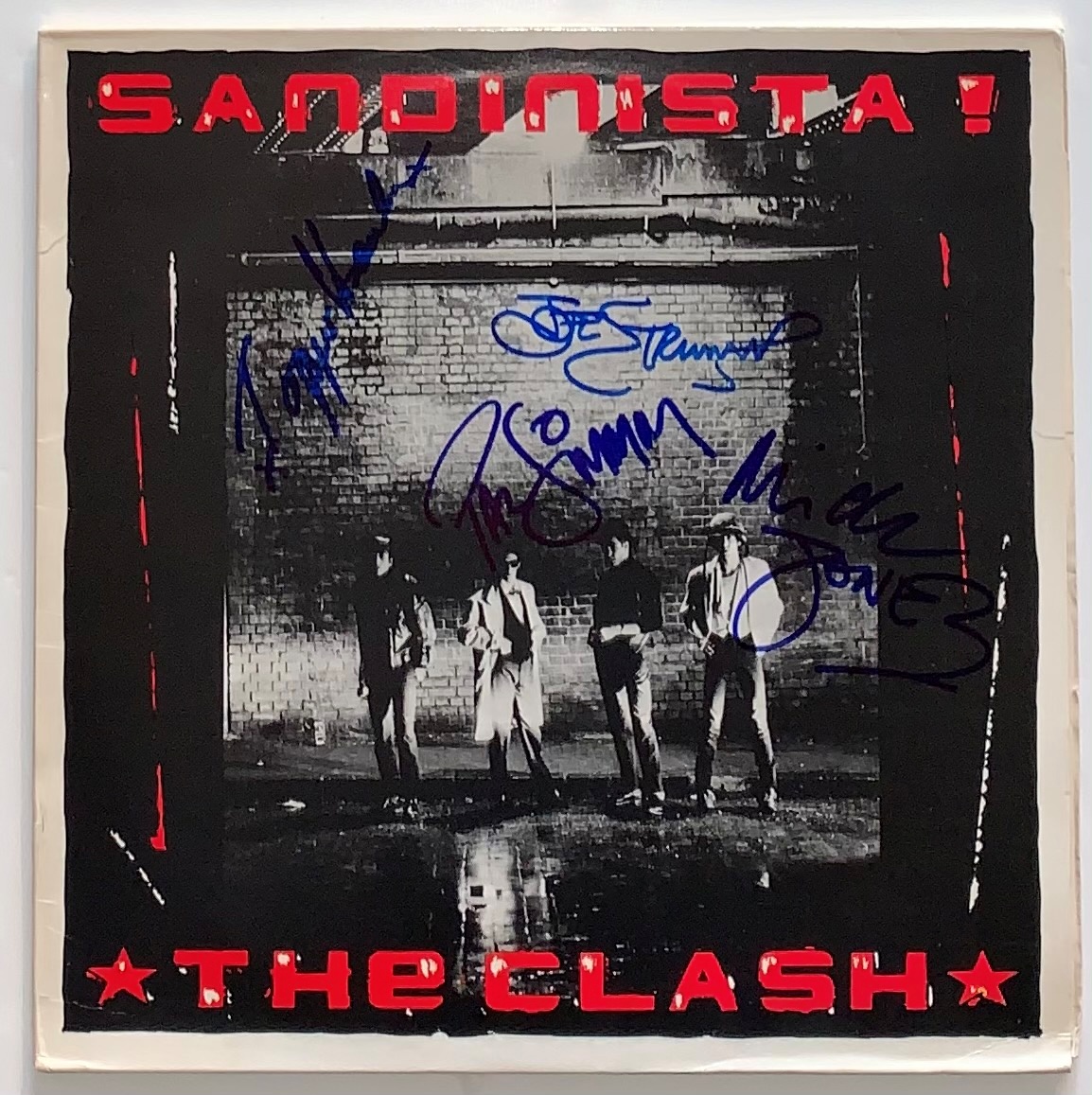
Sandinista!
The Clash's most ambitious record is also my favorite. Here's why I think history has finally caught up with it.
I am going to say something that will get me politely escorted out of certain record-store conversations:
Sandinista! is my favorite Clash record.
Not only is it my favorite Clash record, it is their best record. Objectively. Scientifically. Peer reviewed by the imaginary academy of people who own too many records and have opinions about bass tones. I will fight you on this.
Just kidding. Mostly.
I know the sensible answer is London Calling. I understand the argument. It is perfect in the way a great double album can be perfect, full of range but still disciplined enough to feel like a band knew exactly when to stop. It has the songs, the myth, the cover, the clear place in history. Nobody sounds foolish calling it the peak.
But Sandinista! is the one I live in.
It is sprawling, funny, exhausted, angry, generous, overstuffed, politically restless, and sometimes completely ridiculous. It is a 36-song triple album that behaves less like a record than a city. There are alleys, radio towers, basement parties, union halls, street corners, churches, pirate transmissions, children shouting in the next room, and somebody somewhere trying to dub the whole mess into outer space. It is the sound of a band refusing to accept that punk had to shrink into a uniform.
That refusal is why I love it. It is also why people have been arguing about it since 1980.
The World Pressing In
The Clash did not make Sandinista! in a vacuum. They made it while Britain was turning meaner, colder, and more suspicious of its own working class.
Margaret Thatcher had been elected prime minister in 1979. By 1980, her government was pushing monetarist economics, attacking the postwar consensus, tightening public spending, and treating organized labor less like a political constituency than an infection. Inflation was still high. Unemployment was climbing fast. Whole industrial communities could feel the floor moving under them. If you were young, working class, Black, immigrant, unemployed, or simply allergic to being told that the market was a moral authority, the air was getting hard to breathe.
There was also a poisonous racial climate. The National Front had not disappeared. Police stop-and-search practices, especially the old sus laws, were a daily humiliation in Black communities. In April 1980, the St Pauls riot in Bristol erupted after a police raid in a neighborhood already strained by unemployment, bad housing, and racial tension. The larger uprisings of 1981 were still ahead, but the weather was already gathering.
So when Sandinista! opens itself to workers, immigrants, soldiers, children, cops, hustlers, singers, and people getting crushed by systems too large to punch directly, it is not dabbling in politics. It is reporting from inside the pressure.
This is one reason the record has never felt bloated to me. Its scale matches its subject. You cannot make a tidy little 10-song album about the human condition unless you are lying or very well rested.
Why Sandinista?
The title matters. In 1979, the Sandinista National Liberation Front overthrew the Somoza dictatorship in Nicaragua, a regime long entangled with United States power. For a band like The Clash, who were suspicious of imperialism in every available flavor, the Sandinistas represented a real historical rupture: people in a small country throwing off a brutal order backed by larger interests.
The album even carried the catalogue nod FSLN1, a reference to the Frente Sandinista de Liberacion Nacional. The title was not a vague revolutionary mood board. It was specific, pointed, and very Clash.
That specificity runs through “Washington Bullets,” one of Joe Strummer’s clearest political songs. It moves through Chile, Cuba, Nicaragua, Afghanistan, and Tibet, taking swings at American power without pretending Soviet or Chinese power was innocent. That distinction matters. The song is not some dorm-room poster of revolution with the hard parts airbrushed out. It is Strummer trying to trace the machinery of empire while still leaving room for ordinary people who get ground up by it.
I do not go to The Clash for policy papers. God help us all if I did. I go to them because at their best they understood politics as lived experience. Rent. Police. Work. Borders. War. Radio. Who gets heard. Who gets disappeared. Who gets called dangerous for wanting a life with dignity.
Sandinista! is full of that.
The Beautiful Nerve Of The Thing
The decision to release this as a triple LP still feels slightly insane, in the best possible way. The Clash had already battled CBS over making London Calling a double album at a consumer-friendly price. With Sandinista!, they pushed the value-for-money idea even harder, accepting reduced royalties so the thing could be sold for far less than a normal three-record set should have cost.
That is easy to romanticize now, but it was not symbolic. It cost them money. The band was not floating above the industry in a cloud of pure principle. They were signed to a major label, making records inside the machine while throwing bolts into it whenever possible. There is always contradiction there. The Clash were full of contradiction. That is partly why they remain interesting.
Still, the gesture counts. A 36-song album sold cheap says something about abundance. It says music should travel. It says the kid with one record-buying decision that month deserves the whole argument, not the deluxe version hidden behind a richer person’s counter.
And what an argument it is.
A Band Becoming A Radio Station
The old line on Sandinista! is that The Clash tried everything. Punk, reggae, dub, calypso, funk, soul, gospel, jazz, folk, early hip hop, rockabilly, children’s voices, tape experiments, whatever was lying around. That is true, but it undersells the record.
Lots of bands try everything and produce a yard sale.
What makes Sandinista! astonishing is that the experiments are tied to a moral and rhythmic imagination. The Clash were not tourists picking up exotic hats. Their relationship with Jamaican music had been developing for years, through reggae covers, friendships, London soundsystem culture, and actual collaboration. By the time Mikey Dread entered their orbit around “Bankrobber” and then Sandinista!, dub was not a decorative spice. It was a way of thinking about space, repetition, pressure, absence, and voice.
Recording at Channel One Studios in Kingston mattered because you can hear the band learning from a place where rhythm is architecture. The dub versions are not bonus curiosities. “One More Dub” is not just “One More Time” with the lights turned off. It teaches you how to hear the whole record: bass as weather, drums as civic infrastructure, echo as memory. The Jamaica connection loosened the band without making them vague.
Topper Headon is crucial here. People talk about The Clash as if the politics came first and the groove somehow reported for duty afterward. No. Topper is why so much of this impossible album moves. He can play punk with force, reggae with patience, funk with snap, and disco with enough lift that “The Magnificent Seven” does not feel like a rock band discovering rap from a distance. It feels like a group realizing the street had changed tempo.
Paul Simonon is just as important, but in a different way. His bass playing has taste, which is rarer than chops and harder to teach. On Sandinista!, he often leaves room for the song to breathe, then drops a line that feels like it has been standing there the whole time waiting for you to notice. “The Crooked Beat” is not an obvious anthem, but its sideways pulse is part of the album’s secret map. Simonon brings weight, style, and a visual sense of drama to the sound. Even when he is not dominating, he is framing the picture.
Joe And Mick, Expanding The Argument
The Strummer-Jones partnership was changing too. Earlier Clash records often feel like sparks thrown from the friction between Joe’s street-preacher urgency and Mick’s melodic intelligence. By Sandinista!, that friction had become more complicated. The songwriting credits were given to the band as a whole for the first time, which fits the record’s collective sprawl, but you can still hear Joe and Mick circling each other.
Mick brings pop architecture. “Somebody Got Murdered” is one of the great Clash songs because it makes dread singable without making it cute. The guitar line gleams, the chorus lands, and underneath it is the terrible ordinariness of violence. “Hitsville U.K.,” with Ellen Foley, is a love letter to independent music that understands pop as a democratic weapon. It sounds almost sweet until you realize how fiercely it believes in small labels, small rooms, and people making culture without permission.
Joe brings the global nervous system. “The Call Up” is an anti-draft song, but it is also about the insult of being asked to surrender your body to someone else’s geopolitical panic. “Washington Bullets” can feel almost too direct until you sit with how much ground it covers and how carefully it refuses easy purity. “Rebel Waltz” sounds like history limping home after the parade.
Together, they stopped writing only about the immediate street in front of them and started writing about the wires connecting that street to the rest of the world.
That is the leap. Sandinista! is not less focused than their earlier work. It is focused on a larger target.
The Mess Is The Method
Yes, there are strange moments. Of course there are. Children sing “Career Opportunities.” There are fragments that feel like overheard broadcasts. There are songs that wander in, sit down for two minutes, and leave before you can decide whether they were joking. There is “Mensforth Hill,” which sounds like someone fed “Something About England” through a haunted piece of machinery and then left the room to make tea.
I understand why that drives some people mad.
But for me, those odd corners are part of the emotional truth of the album. Life does not arrive in properly sequenced singles. Politics does not pause so the chorus can breathe. Grief, comedy, boredom, rage, and tenderness do not wait for their assigned side of vinyl. Sandinista! feels human because it is uneven in the way a day is uneven.
And still, I will defend the “no-skip” claim. Not because every song is equally great in the boring spreadsheet sense. Because every piece contributes to the world of the record. Skip one and you may not lose a classic, but you lose a doorway.
“Police on My Back” charges like a getaway car. “Junco Partner” stumbles beautifully through older folk and New Orleans pathways before becoming something the band can inhabit. “Up in Heaven (Not Only Here)” turns housing alienation into a roar. “Charlie Don’t Surf” pulls Vietnam, Hollywood, and imperial arrogance into one bitter little phrase. “The Sound of Sinners” goes gospel because apparently by side whatever-we-are-on-now The Clash have decided to storm the church too.
And then there is “The Magnificent Seven,” which still sounds like a miracle of timing. Recorded in New York as hip hop was moving from park jams and clubs toward records, it is not a perfect rap song, and it does not need to be. It is a band with ears open, trying to understand a new rhythmic language in real time. The bassline struts. The lyric turns workday capitalism into absurd theater. The whole thing feels like a subway door opening onto the next decade.
Why People Did Not Know What To Do With It
The divided reaction in 1980 makes sense. Imagine waiting for the follow-up to London Calling and receiving a three-record political dub-punk-funk-gospel broadcast with children’s choirs and anti-imperialist history lessons. Some critics heard ambition. Some heard indulgence. Some probably heard the sound of their deadline collapsing.
The British press, in particular, could be harsh. The album was too much, too loose, too far from the approved punk storyline. The old critical complaint was that there was a great single album buried inside it, which is the kind of thing people say when a record refuses to behave and they want to sound practical.
I have never bought that argument. A single-LP Sandinista! might be cleaner, but it would not be Sandinista! The excess is not a flaw sitting on top of the work. It is the work. Cut it down and you get a respectable album. Leave it alone and you get a world.
History has been kinder because history finally caught up with the format. We now live in musical abundance all the time. Playlists jump continents in three songs. Genres leak into each other before lunch. Bedroom producers treat dub, rap, punk, dance music, and folk memory as available colors. The idea that a band might want to make a record that behaves like a global radio dial no longer seems reckless. It seems prophetic.
The album’s reputation has grown for that reason, but also because its politics did not expire. Anti-imperialism did not become quaint. Racism did not pack up. Capitalism did not discover a conscience. Police power, unemployment, displacement, militarism, and media nonsense are still with us, wearing updated shoes.
That is not comforting, exactly. But it does explain why Sandinista! keeps sounding current in ways that must annoy the people who once called it a mess.
The Record As Home
I have lived with this album for decades, which means I no longer hear it as a sequence of arguments. I hear it as a place I can go.
There have been periods in my life when I needed records that did not ask me to be simple. Sandinista! has helped me through some very difficult stretches because it contains so many emotional temperatures. It can be angry without becoming brittle. It can be funny without getting smug. It can be politically serious without turning into homework. It can be sad, but it keeps moving.
That movement matters. When I put it on, I feel grounded. Not soothed exactly. This is not spa music unless your spa is run by unemployed Marxists with a delay unit. But grounded, yes. The record reminds me that confusion is not failure. That trying too much can be noble. That the world is connected in ways both beautiful and brutal. That music can hold contradiction without solving it.
The Clash were not saints. No band is. Saints usually make terrible records anyway. They were four people with egos, appetites, blind spots, debts, brilliance, and a dangerous amount of nerve. On Sandinista!, they opened the doors wider than most bands would dare and let the whole noisy century wander in.
I am grateful every time.
Final Spin
This record still matters to me because it believes ordinary lives are worth the full scale of art. Workers, immigrants, kids, soldiers, musicians, people in towers, people in alleys, people under flags they did not choose. Sandinista! looks at all of them and says the story is bigger than the market will admit.
I suspect I will still be listening to it when I am an old man because it has never required me to be the same person twice. It has room for anger, grief, jokes, politics, memory, and the dumb joy of a bassline that hits exactly right. Some records you admire. Some records you visit.
This one feels like home.